Commercial Leases: Gross, NNN and Everything in Between
By Barry Hardwick, CCIM
One of the most perplexing parts of leasing commercial real estate is the terminology surrounding leases: Gross lease, Modified gross, Net lease, Triple net, and Absolute net. For a business owner opening their first location, this can make an already complicated process seem overwhelming; and the truth is, there is no universally accepted industry definition for each lease type.
One of the most common misconceptions is that a gross lease is good for the tenant and a triple-net lease is bad.
It isn’t that simple. Every commercial property has expenses. We all know what they are: property taxes, casualty and liability insurance, utilities, repairs and maintenance of the building systems which include the roof, electrical, plumbing, HVAC and other services such as maintaining the parking lot, landscaping, and common areas.
The lease does not create these expenses. The lease determines who is responsible for performing and paying for them.
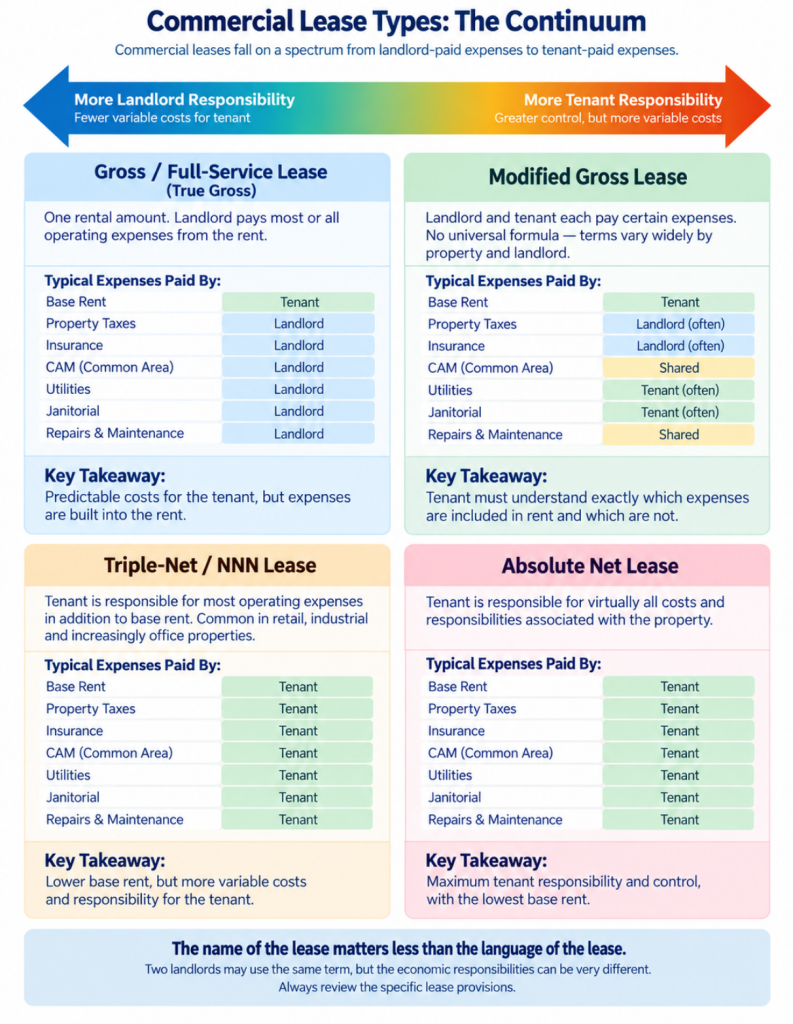
Commercial leases can therefore be thought of as a continuum. At one end is a true gross or full-service lease, where most operating expenses, if not all, are included in the tenant’s rent and paid by the landlord. At the other end is an absolute net lease, where virtually all costs and responsibilities associated with the property are shifted to the tenant. Most commercial leases fall somewhere in between. Thus, the continuum describes the leases according to how operating expenses are allocated between the landlord and tenant. Let’s look at some examples.
1. Gross or Full-Service Lease
Under a gross lease, sometimes called a full-service lease, the tenant generally pays one rental amount, and the landlord pays the property’s operating expenses from that rent. Full-service leases are commonly associated with multi-tenant office buildings, and these operating costs are typically included within the rent. For the tenant, the advantage is obvious: predictability. If the rent is $30 per square foot, the tenant may know reasonably well what its occupancy cost will be. But that does not mean the tenant isn’t paying the building expenses. The landlord has simply estimated those expenses and incorporated them into the rental rate.
For example, suppose a landlord needs $20 per square foot in net rental income and expects operating expenses to be $10 per square foot, then the gross rental rate quoted by the landlord will be $30 per square foot. The tenant is still paying the expenses. They are simply bundled into the rent.
And even many leases described as “gross or full service” contain provisions that allow increases in operating expenses to be passed through to the tenant via an expense stop or base-year provision whereby expenses above these thresholds are paid by the tenant. So, the word gross by itself does not tell the entire story.
2. Modified Gross Lease
A modified gross lease falls somewhere between a full-service or gross lease and a net lease. The landlord pays certain expenses while the tenant pays others. There is no universal or standard formula. For example, the landlord might pay the real estate taxes, insurance, roof and structural repairs while the tenant pays directly for their utilities, repairs and maintenance and their pro-rata share of the common area expenses. Another Landlord’s modified gross lease might allocate those expenses completely differently.
CCIM, one of the leading industry trade groups, describes a modified gross lease as “some operating expenses are included in base rent while others are paid separately by the tenant.” The emphasis is 1) there is not a set standard and 2) that the tenant must understand exactly which expenses are included in rent and which are not. Two landlords may both describe their lease as “modified gross,” yet the economic responsibilities imposed on their tenants could be substantially different.
3. Triple-Net / NNN Lease
Under a typical Triple Net lease, the tenant is responsible for their direct expenses (such as separately metered utilities, janitorial, repairs & maintenance of the building systems inside their premises) and their pro-rata share of the property taxes, insurance and common area expenses or CAM which include landscaping, parking lot maintenance, exterior lighting and similar type expenses shared by all of the tenants. Triple Net leases are commonly used in retail and industrial leasing, and are becoming more common in office and medical office properties, with the tenant paying operating expenses in addition to base rent. The expenses are commonly referred to as “triple nets”
Suppose a retail space is quoted at: Base Rent @ $25.00 per square foot and Triple Nets @ $7.00 per square foot. The tenant’s initial occupancy cost therefore is $32.00 per square foot plus their direct expenses.
Typically, the major difference between a Modified Gross Lease and a Triple Net lease is how the expenses are allocated, who bears the risk of increases, and how increases are calculated and billed to the tenant. Under the modified gross lease, the landlord collects the rent and pays the expenses. Under the NNN lease, the tenant pays base rental rate and its share of the triple nets. The expenses exist either way and the tenant will typically bear increases in those expenses throughout the lease term. The question is – “is the landlord reimbursed via a Triple Net charge or via an Expense Stop or Base Year calculation?”
4. Absolute NNN Lease
An absolute NNN lease goes considerably further. This is the extreme end of the expense-allocation continuum. Under an absolute net structure, the tenant will be responsible for all building expenses such as property taxes and insurance, and routine operating expenses such as utilities, repairs and maintenance, and for virtually every cost associated with maintaining, repairing and replacing the property. Depending upon the lease, that could and in most cases does, include major capital items.
The intention of an absolute-net lease is that the landlord receives rent without being called upon to operate, maintain or fund the property. This structure is commonly associated with long-term, single-tenant net-leased investments.
It is important, however, not to assume that every lease labeled “NNN” is an absolute NNN lease. In fact, there is a significant difference between them.
A typical shopping-center NNN lease may require the tenant to pay its proportionate share of operating expenses while the landlord continues to maintain the center and remains responsible for certain structural or capital obligations. Whereas an absolute NNN lease will shift many or all those responsibilities to the tenant. Again, read the lease—not merely the label.
There Is No Free Lunch
All commercial properties have expenses. The lease does not create these expenses. It simply determines who is responsible for performing and paying them. The landlord who agrees to pay taxes, insurance and maintenance is not generally agreeing to absorb those expenses without compensation. The landlord considers those costs when establishing the rental rate. When comparing lease rates, the real question is not “Is this a gross lease or a NNN lease?” The better question is: “what is my total occupancy cost, what expenses am I responsible for performing, and how can those expenses change during the lease?”
The Bottom Line
Commercial lease terminology can make the process sound more complicated than it really is.
Remember: every property has operating expenses. A gross lease places more of the responsibility for performing and paying those expenses with the landlord. An absolute NNN lease places all that responsibility with the tenant. Modified gross and traditional retail NNN leases fall somewhere between those two extremes. Most commercial leases are some form of hybrid.
The Bottom Line is the Tenant should understand the economic arrangement behind the terminology. Who pays what? How much will it cost? Who bears the risk if those costs increase? And who is responsible for maintaining, repairing and replacing a building component when something major fails? Once those questions are answered, the alphabet soup of commercial leasing becomes much easier to understand.
Get in touch
Leave your name and email below along with what you are looking for in the message box. Or you can call us at 615.234.4900.